Germany is a diverse country with many attractions! The combination of old world charm and modern urban cities make it an ideal destination for travelers. With a wide array of food, accomodations and drink options, Germany is traditionally less expensive to travel to than its other European counterparts. Below are just a few reasons Germany should be on your bucket list!
1. Germans love to celebrate. From Oktoberfest to Christmas markets to Carnival and the famous Rhine in Flames, Germany features a fair to celebrate everything!
2. The home of Bach and Beethoven, Germany boasts around 300 theatres, 130 professional orchestras and 630 art museums with internationally acclaimed collections. This is ideal for the travelers interested in the fine arts.
3. Even though German is the primary language, many also speak English, making it easy for non-German speaking visitors to communicate.
4. The country is crisscrossed by 7,900 miles of autobahn and a rail network of nearly 21,800 miles. This extensive system makes traveling by car or rail extremely easy.
5. Divided into 16 diverse states, the country has a region and activity for everything. Plus, each state has different food and drink specialties.
6. Thirteen national parks offer a quiet escape from the fast pace of city life.
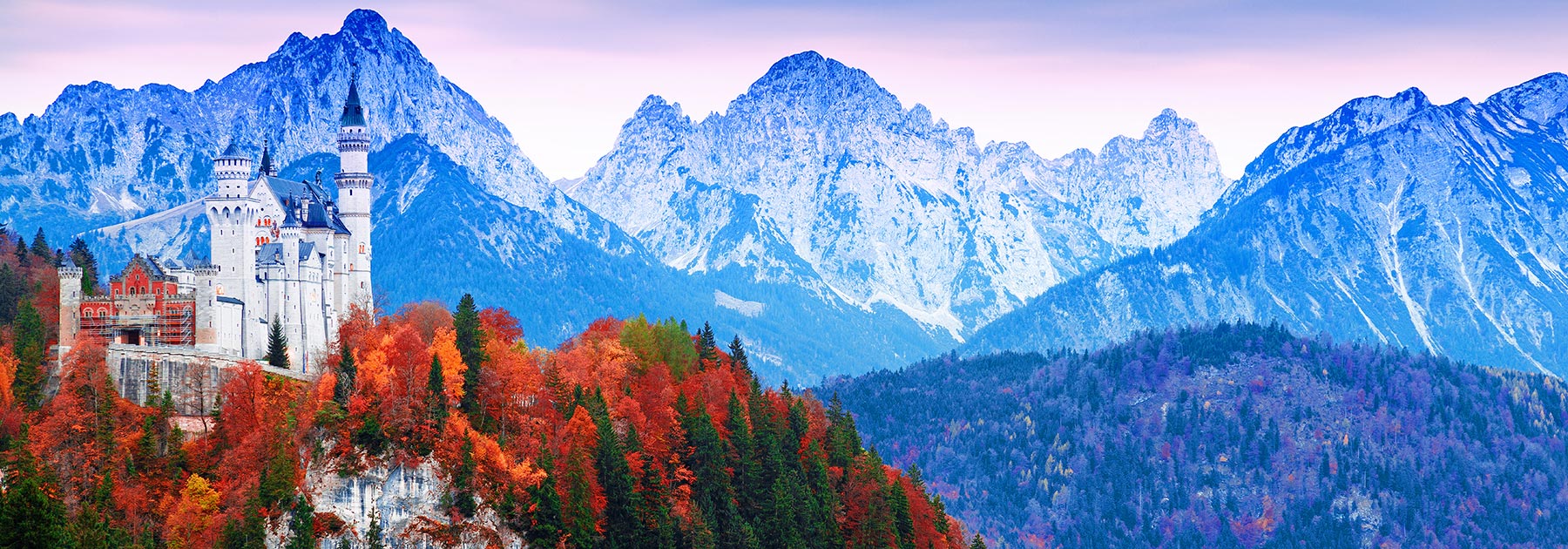
7. Neuschwanstein was the inspiration for Disneyland’s Sleeping Beauty Castle and is an easy day trip from Munich. This stunning structure is the ideal of romantic architecture, and is one of the many fairytale castles dotted throughout Germany.
8. Germans know how to relax and unwind! With over 1,000 wellness and beauty hotels, 350 health resorts and spas and an extensive range of specialist clinics they make it easy to return home feeling refreshed.
9. As the home of the high performance car, Germany is the place to experience an adrenaline rush. With over 200 attractions and museums offering car and technology themed activities it is easy to please any car enthusiast. Or… even better, rent a car for a drive on the autobahn, where there are no speed limits!
10. Germany is synonymous with innovation and cosmopolitan living, and has three cities with a population larger than one million. These modern cities offer a variety of music, shopping, bars and nightlife that are sure to entertain those young and old.
Berlin is a tense city, from its fashion to its architecture to its charged political history. The Berlin Wall is a sobering reminder of the postwar, overburdened atmosphere, and yet the graffiti that cover its remains today has become a symbol of social progress. Visit the Weltzeituhrhr (world time) clock, crowned with a model of the solar system, then travel back in time to dinner in the historic Zur Letzten Instanz, a 16th-century restaurant frequented by Napoleon and Beethoven.
On the banks of the beautiful river Elbe, the German city of Dresden is lush and green, full of forests, gardens, and parks. The city has a lot of cultural and artistic history; The great opera composer Wilhelm Wagner premiered many plays here in the 19th century and today an independent operetta company keeps classical art updated and modern. The cultured people will love the museums Gemäldegalerie Alte Meister and Grünes Gewölbe, and architecture aficionados will be amazed by the mélange of styles reflected in the urban landscape.
Munich transmits a Bavarian charm. Beer fans should visit Hofbräuhaus without missing a second, a jump into the sky that produces this excellent drink since 1589. The drink is definitely legendary during Oktoberfest, a celebration of local beers and German special foods. Imitate the world athletes at Olympiapark, where you'll feel like a champion skating on the Olympic ice rink. The walk along the Marienplatz is perfect for people who look in amazement at the Glockenspiel of the Town Hall.
The largest and most populated city after Berlin, Hamburg is home to one of the largest ports in Europe. A walk through its many channels and canals will show why it is called the "Venice of the North". Do not miss a tour of the local fish market (Fischmarkt), the commercial district (characterized by its impressive red brick architecture), an exquisite gastronomic experience by the river or a night out on the university district. And we talked about Reeperbahn (the Red Light District)? It is very famous for its red lights.
If you want to enjoy beautiful views, walk along the top of the ramparts of Rothenburg or go up to the town hall. The night watchman's route is an unforgettable way to know the history of the city. Our travelers also recommend the Medieval Museum of Crime (Mittelalterliches Kriminalmuseum); It is truculent but fascinating.
Take your family to this popular tourist village, in the extreme south of Germany, where you will find the widest offer in snow sports. There are many ski resorts around Oberstdorf; Such as Nebelhorn, Kanzelwand / Fellhorn or Kleinwalsertal. Headquarters of the Nordic World Ski Championships in 2005, Oberstdorf boasts the second longest springboard in the world, where ABC recorded a famous video clip ...
Although it is the most northerly island of all the German islands of the North Sea, Sylt enjoys warm currents of the gulf. It is a very popular tourist destination, and serves as a playground for the wealthy, with its international pijo brands under traditional thatched roofs. A long and slender island, Sylt boasts 40 km of the beach from north to south, so get yourself a wicker beach chair and relax in this paradise in the North Sea.
At the border with Austria lies the highest mountain in Germany, Zugspitze, which provides an incredible experience for skiers. It has almost 121 kilometers of track of all levels of difficulty, as well as 110 kilometers of cross-country skiing, an all-terrain park, and the first super-pipe in Germany.
Winter sports enthusiasts will feel at home in Berchtesgaden, a town in the German Alps with several ski slopes and an excellent bobsleigh track. Visit the salt mines of Berchtesgaden (TripAdvisor travelers speak wonders about their ramps!). The nearby Lake Königsee is the perfect complement to an ideal excursion.
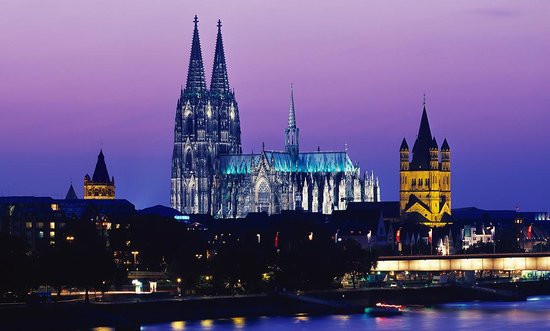
Cologne has 2,000 years of history, and visitors will find everything from Roman towers, Gothic churches, to sophisticated examples of modern architecture. In addition, it has a great variety of museums: visit the Museum of Applied Arts, the Ludwig Museum and, if you are greedy, the Museum of Chocolate. Of course, we warn you: the last museum gift shop will ruin your diet completely.
So much to see, so little time. How to choose? To help you get started, I've listed my top picks for where to go in Germany, my plan for your best three-week trip, and tips on when to go.
Depending on the length of your trip, and taking geographic proximity into account, here are my recommended priorities:
3 days: Munich, Bavarian castles
5 days, add: Rhine Valley, Rothenburg
7 days, add: More of Bavaria and Tirol, side-trip to Salzburg
10 days, add: Berlin
14 days, add: Baden-Baden, Black Forest, Dresden
17 days, add: Nürnberg, Mosel Valley, Trier
21 days, add: Würzburg, and slow down
More time: Choose among Frankfurt, Cologne, Hamburg, Leipzig, and the Martin Luther towns (Erfurt and Wittenberg).
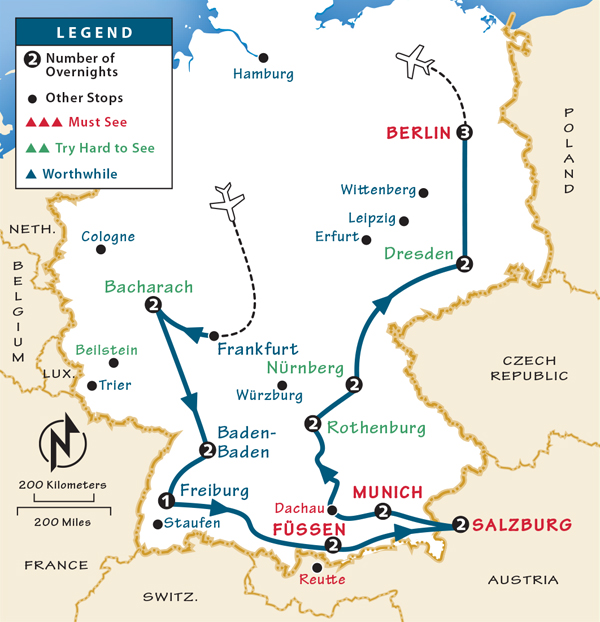
Germany's Best Three-Week Trip (by Car)
Day 1: Fly into Frankfurt, pick up car, drive to Rhine Valley (sleep in Bacharach)
Day 2: Rhine Valley (sleep in Bacharach)
Day 3: To Mosel Valley (sleep in Beilstein or Trier)
Day 4: Mosel Valley and/or Trier (sleep in Beilstein or Trier)
Day 5: To Baden-Baden (sleep in Baden-Baden)
Day 6: Relax and soak in Baden-Baden (sleep in Baden-Baden)
Day 7: Drive through the Black Forest (sleep in Freiburg or Staufen)
Day 8: To Bavaria and Tirol (sleep in Füssen or Reutte)
Day 9: Bavaria/Tirol and castles (sleep in Füssen or Reutte)
Day 10: More Bavaria/Tirol, then to Munich (sleep in Munich)
Day 11: Munich (sleep in Munich)
Day 12: More Munich, or side-trip to Salzburg (sleep in Munich)
Day 13: To Dachau, then follow Romantic Road to Rothenburg (sleep in Rothenburg)
Day 14: Rothenburg (sleep in Rothenburg)
Day 15: To Würzburg, drop off car*, then train to Nürnberg (sleep in Nürnberg or Würzburg)
Day 16: Nürnberg (sleep in Nürnberg)
Day 17: Train to Dresden (sleep in Dresden)
Day 18: Train to Berlin (sleep in Berlin)
Day 19: Berlin (sleep in Berlin)
Day 20: Berlin (sleep in Berlin)
Day 21: Fly home
*After Day 15, you're visiting well-connected cities, making a car unnecessary. Drop the car in Würzburg to save several days of car-rental costs and parking fees.
Smaller Towns vs. Bigger Towns: This itinerary (especially the first half) is heavy on half-timbered villages — a German specialty. But for some, a little cuteness goes a long way. Depending on your preference, plan your overnights to maximize or reduce quaintness..
With Less Time:If I had to pare this trip down to two weeks, I'd make the following changes: Skip the Mosel (a sleepier version of the Rhine), and go directly from the Rhine to Baden-Baden. From Baden-Baden, head straight for Füssen/Reutte instead of overnighting in Freiburg/Staufen. Skip the Salzburg side-trip; choose between Würzburg and Nürnberg, and stay just one night there; and reduce the stay in Berlin to two nights.
With More Time: Salzburg is each easily worth another day; Berlin merits several days more. Depending on your interests, you could stay a day in Frankfurt (upon arrival) and add another day for the Rhine to visit Cologne from Bacharach. The Martin Luther towns (Erfurt and Wittenberg) and Leipzig fit well between towns to the west and south (Frankfurt, Nürnberg) and those in the north and east (Berlin, Dresden). Hamburg isn't on the way to anything in Germany, but it's a worthwhile detour for those headed north to Denmark.
Germany's Best Three-Week Trip (by Car)
A road trip from Stockholm, Sweden to Berlin, Germany via Denmark crossing the resound Bridge. Then took a ferry from Rodby, Denmark to Puttgarden, Germany, travelling time of the ferry is 45 minutes. The distance covered from Stockholm to Berlin is 1084 KM.
Germany Tours is an official web page designed to inform the people who want to know more about this beautiful country, GERMANY!
GermanyTour.com also have a lot of information if you planned to travel to Germany!, We have different itineraries around Germany and also We have all the information you need to travel to Germany...
Tours Suggestions
Neuschwanstein Castle and Lindenhof Palace Day Tour from Munich
Being a federal republic, Germany is very much a decentralised country, which embraces the cultural differences between the regions. Some travellers will perhaps only think of beer, Lederhosen and Oktoberfest when Germany comes to mind, but Germany's famous alpine and beer culture is mostly centered around Bavaria and Munich. Here the beer is traditionally served in 1 litre mugs (normally not in pubs and restaurants, though).
Oktoberfest
The annual Oktoberfest is Europe's most visited festival and the world's largest fair. Germany's south-western regions, however, are well known for their wine growing areas (e.g. Rheinhessen and Palatinate) and Bad Dürkheim on the 'German Wine Route' (Deutsche Weinstraße) organises the biggest wine festival worldwide with over 600,000 visitors annually.
"German Unification Day".
The fall of the Berlin Wall in 1989 and the subsequent German Reunification are the main events of recent German history. Today most Germans as well as their neighbours support the idea of a peaceful reunified Germany and while the eastern regions still suffer from higher unemployment and of brain drain, the reunification process is overall seen as a success. October 3rd is celebrated as "German Unification Day".
Cars are a symbol of national pride and social status. Certainly manufacturers such as Audi, BMW, Mercedes, Porsche and Volkswagen (VW) are world famous for their quality, safety and style. This quality is matched by Germany's excellent network of roadways including the renowned Autobahn network, which has many sections without speed limits that attract speed hungry drivers. There are actually speed tourists who come to Germany just to rent an exotic sports car and fly down the autobahn. Amazingly for its size Germany is home to the sixth largest freeway/motorway network in the world. Germany also features an extensive network of high speed trains - the InterCityExpress (ICE).
German football culture
Football culture in Germany
German fans are loud and often go the extra mile to support their teams, with very creative choreographed flags known as “tifos.” German fans from clubs such as Eintracht Frankfurt or Dynamo Dresden are known all over Europe for their tifos and chores.
The Germany national football team has won four FIFA World Cups (1954, 1974, 1990, 2014), is the joint-second most successful nation in the tournament only surpassed by Brazil. It also holds a record (tied with Spain) for three UEFA European Championships (1972, 1980, 1996), and won the FIFA Confederations Cup in 2017.
Is the largest country in Central Europe. Denmark bordered it to the north, to the east by Poland and the Czech Republic, to the south by Austria and Switzerland, and to the west by France, Luxembourg, Belgium, and the Netherlands. Germany is a federation of 16 states, roughly corresponding to regions with their own distinct and unique cultures.
Germany is one of the most influential European nations culturally, and one of the world's main economic powers. Known around the world for its precision engineering and high-tech products, visitors equally admired it for its old-world charm and "Gemutlichkeit" (coziness). If you have perceptions of Germany as simply homogeneous, it will surprise you with its many historical regions and local diversity.
Population = 81,799,600 (2010 estimate)
Quick Facts
Capital = Berlin
Government = Federal Republic
Currency = Euro (€)
Area = 357,022km²
water = 8,350km²
land = 348,672km²
Language = German
Electricity = 230V,50Hz (Euro plug, Type F, & Shuko plugs)
Country code = +49
Internet = TLD.de
Time Zone = UTC +1
Emergenciesdial = 112
When to Go?
The "tourist season" runs roughly from May through September. Summer has its advantages: the best weather, snow-free alpine trails, very long days (light until after 21:00), and the busiest schedule of tourist fun.
Travel during "shoulder season" (April, May, September, and early October) is easier and can be less expensive. Shoulder-season travelers usually enjoy smaller crowds, decent weather, the full range of sights and tourist fun spots, and the ability to grab a room almost whenever and wherever they like — often at a flexible price. Also, in fall, fun harvest and wine festivals enliven many towns and villages, while forests and vineyards display beautiful fiery colors.
Winter travelers find concert seasons in full swing, with absolutely no crowds, but some accommodations and sights are closed or run on a limited schedule. Confirm your sightseeing plans locally, especially when traveling off-season. The weather can be cold and dreary, and nightfall draws the shades on sightseeing well before dinnertime. But dustings of snow turn German towns and landscapes into a wonderland, and December offers the chance to wander through Germany's famous Christmas markets (this tinseled fun often comes with higher hotel prices, but also longer museum hours).
Winter travelers find concert seasons in full swing, with absolutely no crowds, but some accommodations and sights are closed or run on a limited schedule. Confirm your sightseeing plans locally, especially when traveling off-season. The weather can be cold and dreary, and nightfall draws the shades on sightseeing well before dinnertime. But dustings of snow turn German towns and landscapes into a wonderland, and December offers the chance to wander through Germany's famous Christmas markets (this tinseled fun often comes with higher hotel prices, but also longer museum hours)
GERMANY - | The Federal Republic of Germany | german capital city | meet the germans
Finding a bed is rarely a problem in Germany and the range of accommodation–from half-timbered hostels to high-rise designer hotels, pension to the palace–means there’s something to suit all budgets and tastes. There are two caveats: during a high Season in premier resorts and during major festivals, when you may struggle to find a room; and when expense accounts roll into town during city trade fairs known as Messen, when you may balk at the prices demanded.
In the past decade, the country’s hoteliers have busied themselves updating what was a fairly frumpy hotel stock to at least a nod to contemporary decor, even if that means a preponderance of identikit, bland furnishings in cheaper places. Another trend is the emergence of an independent hostel sector. Though targeted at the backpacker market, these convivial hostels are open to all comers and often offer cheerful modern doubles for around €20; less than you’d pay for a tired, cheap hotel. Even the latter are clean, even if their decor saps the spirit.
While the strength of the euro means hotel accommodation is not quite the bargain of a decade ago, Germany remains at a good value compared with the United Kingdom at least.
Notwithstanding that prices vary hugely, you can expect to pay around €80–120 for a double in an average mid-range hotel. Many city hotels, especially those that target the executive market, offer cheaper weekend rates. Hostels charge about half that price for a double room, and under €30 for a dormitory. The other source of a cheap bed is rooms in private houses or farms–those in more remote regions such as the Black Forest and Bavarian Alps abound in country character and provide bargains to boot.
A peculiarly German quirk is the enduring love affair with the sauna and spa or “wellness” center, which you’ll find even in dated hotels–worth remembering before you thrill to the notion of a “spa hotel”. Another national tradition is the Kurtaxe, which is charged in spa towns and “health” resorts, a definition extended to encompass most coastal resorts.
This adds €2–4 to your hotel bill because they lay facilities on for the resort’s tourists.
For reservations, most tourist offices will book all forms of accommodation either for free or for around €2–4 per person. Those in resorts are a good, first port-of-call if you arrive without a reservation in peak season. Many in destinations with a high visitor rate have touchscreen info points outside, sometimes with a free telephone. And if you make a reservation, be sure to notify staff about an expected arrival time after 6pm – or else your room may be given away.
Hotels
Many hotels in Germany have aligned themselves with a voluntary five-star Deutschen Hotelklassifizierung rating system based on an independent body's assessment of 280 criteria. This ensures that taking part in one-star establishments have rooms of up to 12m squared, with en-suite toilet and shower; that three-star hotels offer larger rooms, a minibar, and 24-hour call-on reception even if they are not manned; and that five-star places, you will enjoy rooms of at least 18m squared and luxuries such as 24-hour room service and reception, and laundry services. Most hotels have a restaurant–those named a “Hotel Garni” serve breakfast only. Whether aligned to the Deutschen Hotelklassifizierung system, German hotels are comfortable enough for you to have few complaints; they are clean en suite except in the cheapest establishments, and rooms nearly always come with a TV. In the lower and mid-range, you can expect either a fairly anonymous business style or a dated Eighties throwback. Budget hotel chains Et al. and Ibis provide functional modern rooms at rates comparable to a room in an independent hostel. That said, a growing number of style hotels in the cities also offer interior style at affordable prices, and at the upper end, you can have a pick of hotels with a wow factor, with many luxury outfits installed in historic palaces or castles. All hotels provide breakfast buffet-style and are included in the price of your room, but do double-check.
Pensions, inns, private rooms, and farm stays
A shift away from the formality and anonymity of blander hotel chains is the pension: smaller, cheaper establishments, often in large houses or in city apartment blocks. What they lack in mod-cons—you’ll usually have to share bathroom amenities, for example – they make up as personal service and homely decor. In Bavaria they are often called a Gästehaus; We can find a similar style in a Gasthof or a Gaststätte, which roughly translates into English as an inn. Accommodation is above a traditional restaurant – that it is often in a historic building is all part of the charm of a stay, although remember this means room dimensions are historic, too. For obvious reasons, these are especially prevalent in small towns and in the countryside. Both pensions and inns will provide breakfast.
A step down from the pension or inn is the private room in the house of locals. Priced from around €15, these are rarely more expensive than €30, making them a valuable alternative to the hostel for budget travelers. At their best, private rooms offer a chance to dip a toe into everyday life and to glean insider information from a local host. Such intimacy may not be to all tastes, however. Tourist information offices can book rooms, look for signs advertising Zimmer Frei or Fremdenzimmer, or source rooms (and apartments) online at bed-and-breakfast.de and bedandbreakfast.de.
One of the most notable developments in German accommodation in the past decade is the rise of farm stays. Beloved by city families as a rural escape, and often good bases for country pursuits such as walking or riding, these are classified either as Landurlaub (country holiday)–former farms or country houses with typical regional charm–or as Urlaub Auf dem Bauernhof (farm holiday) which provide rooms on working farms and vintners. Many of the latter feature homemade produce for breakfast and, occasionally, evening meals–but you’ll obviously need your own transport. Again, local tourist offices can recommend farm stays, or try farm stay organizations, all of which sell brochures or guidebooks.




 Day 1:


.jpg)




.jpg)
